L&R Care home podiatry UK
Diabetic Foot Assessments for Care Homes in the UK
Protect your residents and improve your clinical outcomes with targeted, preventative podiatry care. Recognise diabetic foot problems early with specialist podiatry from our team. We provide comprehensive, compliant & documented assessments.
Diabetic Foot Assessments
| 1. Maintaining Foot Health | Diabetic Foot Assessments are crucial for maintaining good foot health and proactively avoiding potential problems, such as ulceration and amputation—the most severe complications. The sooner a problem is discovered, the better the prognosis. |
| 2. Crucial Risk Detection | We can identify whether your diabetic residents are low, medium or high risk after our detailed diabetic assessment. |
| 3. Prevention and Education | The assessment provides a clear risk score, leading to a tailored preventative care plan and specific advice for residents and care home staff on daily checks and management. Also, whether your residents may be entitled to regular NHS Podiatry treatment. |

Compliance, Reporting, and Partnership
Any Diabetic Assessments carried out will be forwarded directly to the care home, which can then be shared with the residents’ GP practice.
What does an assessment involve?
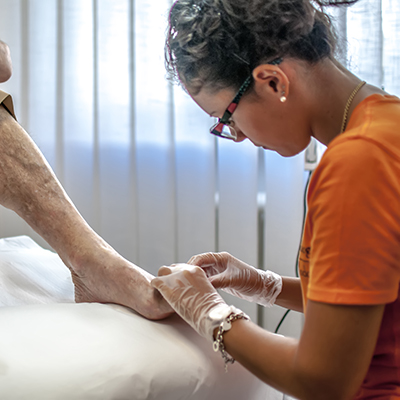
A diabetic foot assessment for a resident involves reviewing a patient’s sensations for altered sensations or numbness, checking for pulses (with and/or without a Doppler), and taking an extensive history to determine the patient’s current diabetic control, among several other factors. This allows us to then classify the patient’s risk levels for potential problems.
Typically, a diabetic assessment is carried out annually by the patient’s GP surgery; however, we are finding that more and more GP surgeries are unable to undertake these assessments, and therefore private companies like ours are having to facilitate them.
How long does a typical assessment take?
A typical assessment will take 15-30 minutes.
Who will conduct the assessment?
The assessment will be carried out by one of our HCPC-registered podiatrists. We take great care, with compassion and professionalism, to support your residents and identify diabetes-related risks before they become more severe.
How are diabetic foot assessments preventative?
Our assessments allow us to classify our patients’ risk levels as low, medium, or high. Low-risk patients are reminded of what they should be doing to keep their feet healthy, as well as what to look out for if a problem occurs. Medium-risk patients will also be reminded of the above, as well as potential issues, and will be made aware that the patient’s GP surgery is to be notified. High-risk patients are generally already under the care of NHS Podiatry; if not, we will recommend a referral ASAP.
How often should assessments be carried out for residents?
It’s highly recommended that diabetic foot assessments be undertaken annually.
If a resident is identified as high risk, what are the next steps?
Suppose a resident is identified as high risk. In that case, we will advise the care home to highlight the findings to their GP and to refer them to NHS Podiatry.
What is the frequency of assessment required for high-risk residents or residents with diabetes?
Once a resident has been highlighted as a high-risk diabetic, they generally receive the required care going forward from the NHS.
What information do we need to provide before a diabetic foot assessment?
We will forward the care home our diabetic assessment template, which can be printed and completed for each resident requiring a diabetic assessment. The care home will be required to fill out the patient’s name and DOB.
How is the assessment report shared with the care home and the resident's GP?
After the assessment, the forms will be left with the care staff for their GP. If preferred, we can forward them electronically.
What specific training or advice is given to care home staff following the assessment?
Each patient who receives treatment has an advice section and a foot care plan in their treatment records. This is updated after each treatment, and then a copy is forwarded to the care home for their records. If there is any urgent advice, this will be communicated directly to a member of staff as well.
join the success
Trusted by Care Homes Across the UK
The service is superb timely, and the staff are so well experienced.
L&R Care Home Podiatry UK
Expert Support With Diabetic Assessments
We are specialists in providing comprehensive, holistic foot care to care home residents. Please get in touch to discuss your residents or family members foot care needs.